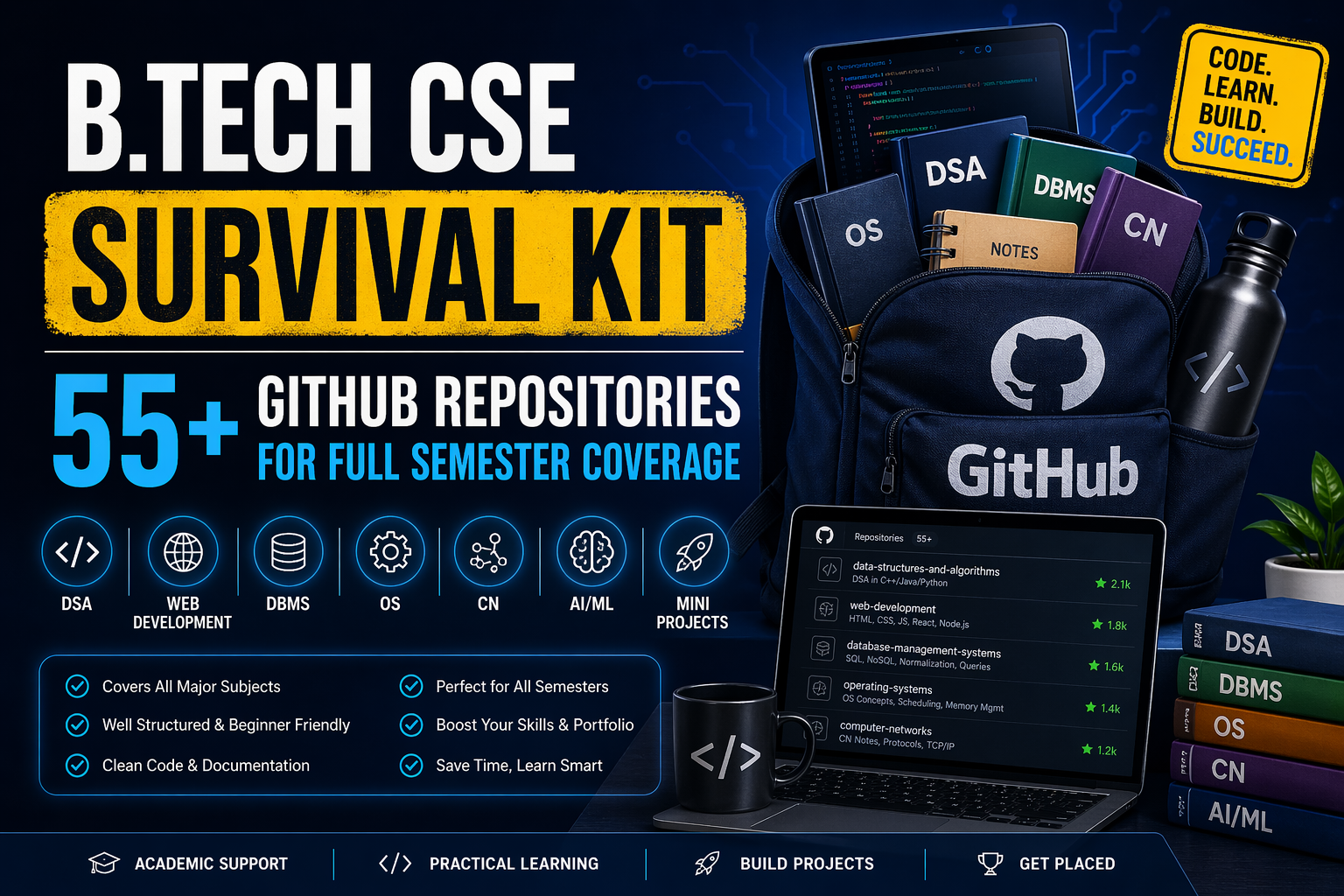
B.Tech CSE Survival Kit: 55+ GitHub Repositories for Full Semester Coverage
A B.Tech in Computer Science can feel like trying to drink from a firehose. One day you’re debugging a printf statement, the next you’re trying to understand the Byzantine Generals Problem in Blockchain.
Textbooks are heavy, expensive, and often outdated. But GitHub? GitHub is the living, breathing library of modern computer science.
I’ve curated and expanded the list you provided into a Complete Semester/Curriculum Notes roadmap. Whether you are a first-year student struggling with Python or a final-year student grinding LeetCode for FAANG, this guide has a repository for you.
Pro Tip: Don’t try to clone all 55 repos at once. Bookmark this page, and come back to it per subject as your semester progresses.
Part 1: Full Semester Coverage (The “All-in-One” Repos)
These are your gold mines. If you lose your notebook the day before the exam, these repos have your back.
| # | Title | GitHub Link | Best For |
|---|---|---|---|
| 1 | JNTUH-CSE-BTech-Notes-R22 | Link | JNTUH students following the R22 regulation (Very syllabus-specific). |
| 2 | JNTU-ALL-SEMS-NOTES | Link | Comprehensive collection for all 4 years (JNTU affiliated colleges). |
| 3 | Academic-Notes-JNTUH-CSE-R18 | Link | Previous regulation (R18) – still relevant for core subjects. |
| 4 | Btech-CSE-Handwritten-Notes | Link | For students who prefer scanned handwritten notes over typed text. |
| 5 | SRM-CSE-NOTES-PART-01 | Link | Specifically for SRM University students (Sem 1-4). |
| 6 | VIT-sem6-notes | Link | Targeted for VIT 6th sem (Cloud, ML, HCI, etc.). |
| 7 | College-Made-Easy | Link | Goldmine. PPTs, question banks, and notes for 6 semesters. |
| 8 | CSE-Notes-All-Semester | Link | University exam-focused notes (OS, CN, DBMS, OOPs). |
| 9 | CS-Notes | Link | Legendary. Interview + core subjects (中文/EN). Best for placement theory. |
| 10 | PwnCollege | Link | For cybersecurity enthusiasts (Hands-on hacking courses). |
Part 2: Subject-Specific Deep Dives
When you need to master one subject, leave the mega-repos and come here.
| # | Subject | GitHub Link | Why it’s good |
|---|---|---|---|
| 11 | DBMS | Link | KTU syllabus specific, but SQL + Normalization concepts are universal. |
| 12 | Operating System | Link | Concise notes. Perfect for last-semester revision. |
| 13 | Computer Networks | Link | Covers TCP/IP, OSI models, and socket programming basics. |
| 14 | DAA | Link | Complexity analysis + Algorithm design techniques. |
| 15 | Machine Learning | Link | Curated list of best video courses (Andrew Ng, Stanford, etc.). |
| 16 | Compiler Design | Link | Lexical analysis to code generation (Sem 6/7). |
| 17 | Artificial Intelligence | Link | Search algorithms, Logic, and AI agents. |
| 18 | Cloud Computing | Link | AWS, Virtualization, and Cloud models. |
| 19 | Cryptography | Link | AES, RSA, DES, and Network Security protocols. |
| 20 | Data Science | Link | The OSSU curriculum – a full degree path for Data Science. |
Part 3: Lab Manuals & Practical Solutions
Theory gets you through the exam; labs get you through the semester. Here are the working codes.
| # | Title | GitHub Link | Language/Domain |
|---|---|---|---|
| 21 | CSE-lab-solutions | Link | Multi-language (C, C++, Java, Python). |
| 22 | DBMS-Lab-Solutions | Link | SQL Queries (DDL, DML, Joins, Procedures). |
| 23 | Python-Lab-Programs | Link | Basic to OOPs in Python. |
| 24 | Java-Lab-Programs | Link | Exception handling, Multithreading, Applets. |
| 25 | Data-Structures-Lab | Link | Linked Lists, Trees, Graphs, Sorting (C++). |
| 26 | CN-Lab-Programs | Link | Socket programming, Client-Server, CRC, Hamming Code. |
| 27 | OS-Lab-Programs | Link | Scheduling algorithms, Banker’s Algorithm, Page Replacement. |
| 28 | Web-Technology-Lab | Link | HTML, CSS, JS, PHP, XML. |
| 29 | ML-Lab-Programs | Link | Regression, Classification, K-Means, PCA (Python). |
| 30 | IoT-Lab-Programs | Link | Arduino, Raspberry Pi, Sensor interfacing. |
Part 4: Interview Preparation (From Intern to FAANG)
You are competing with thousands of students. These repos are your secret weapon.
| # | Title | GitHub Link | Focus Area |
|---|---|---|---|
| 31 | CSE-Interview-Preparation | Link | Company-specific (TCS, Infosys, Wipro) + Core CS. |
| 32 | Mock-Interview-Preparation-for-CSE | Link | HR questions + Technical Q&A. |
| 33 | Tech-Interview-Handbook | Link | Best for FAANG. How to actually pass Google/Meta interviews. |
| 34 | InterviewBit-Solutions | Link | Solutions to the famous InterviewBit platform. |
| 35 | DSA-Interview-Questions | Link | Topic-wise DSA problems (Arrays, DP, Graphs). |
| 36 | System-Design-Primer | Link | The Bible of System Design. For SDE-2 and above. |
| 37 | Coding-Interview-University | Link | The “Meta” plan. A 8-month study plan for Google. |
| 38 | LeetCode-Solutions | Link | Neetcode’s solutions (Best pattern-based learning). |
| 39 | GeeksforGeeks-Solutions | Link | GFG problem solutions (Topic wise). |
| 40 | Placement-Preparation | Link | Roadmap + Resources + Company specific guides. |
Part 5: Free Books & PDFs (Stop paying for PDFs)
Don’t buy expensive books before checking these links.
| # | Title | GitHub Link | Contains |
|---|---|---|---|
| 41 | Free-Programming-Books | Link | The largest collection (1000+ free books). |
| 42 | CSE-Books | Link | Subject-wise PDFs (Core CS). |
| 43 | Computer-Science-Books | Link | Curated list of best CS books. |
| 44 | Data-Science-Books | Link | Python DS, Pandas, Numpy, Scikit. |
| 45 | Algorithms-Books | Link | CLRS simplified + Code. |
| 46 | Python-Books | Link | Jupyter notebooks + Text. |
| 47 | Java-Books | Link | Effective Java, Core Java, etc. |
| 48 | JavaScript-Books | Link | Must read. Deep dive into JS. |
| 49 | ML-Books | Link | List of ML frameworks + books. |
| 50 | CP-Books | Link | For Codeforces/CodeChef prep. |
Part 6: The “Extras” (Roadmaps & Projects)
Want to actually build things? Start here.
| # | Title | GitHub Link | Why |
|---|---|---|---|
| 51 | Awesome-CS-Learning | Link | A full free CS degree curriculum. |
| 52 | Project-Based-Learning | Link | Learn by building (e.g., Build a Redis clone, a Robot, a Compiler). |
| 53 | Developer-Roadmap | Link | Visual roadmap for Frontend, Backend, DevOps. |
| 54 | Build-Your-Own-X | Link | Coolest repo. Build your own Git, SQLite, or Docker. |
| 55 | FAANG-Preparation | Link | Complete guide to get into top tech companies. |
Final Advice for the B.Tech Student
- Don’t copy-paste lab codes. Use the lab repos to debug your code, not to replace your learning. If you copy, you fail the viva voce.
- Use the Interview repos from Year 2. Don’t wait until 4th year. Start solving LeetCode (Repo #38) in your 2nd year.
- Combine theory with projects. Read the “Compiler Design” notes, then visit “Build Your Own X” (#54) to build a tiny compiler.
- Star this article. You will need to come back to it in your 3rd year when you forget what a “semaphore” is.
FAQs
A: Yes, 100% free. No payment or sign-up required.
A: Start with #7 (College-Made-Easy) or #9 (CS-Notes) – they cover maximum syllabus.
A: Yes. Core subjects (OS, DBMS, CN, DSA) are same everywhere.
A: Click green “Code” button → “Download ZIP”.
A: Mostly yes, but may need minor fixes. Use as reference, not blind copy.
A: #33 (Tech Interview Handbook) + #38 (Neetcode LeetCode) + #36 (System Design Primer).