

1. The Big Picture
text
SOURCE CODE                     MACHINE CODE
(hello.c)   →  [ COMPILER ]  →  (hello.exe / a.out)
A compiler is a translator from a high-level language (C, C++, Rust, etc.) to low-level machine instructions (binary) that a CPU can execute.
But internally, it’s not a single step — it’s a pipeline of phases.
2. The Six Major Phases (With Visuals)
Let’s take a tiny C program:
c
int add(int a, int b) {
    return a + b;
}
Phase 1: Lexical Analysis (Tokenization)
Input: stream of characters
Output: tokens (atoms like keywords, identifiers, operators, literals)
text
characters:   i n t   a d d ( i n t   a , i n t   b )
tokens:       KEYWORD(int)  IDENT(add)  LPAREN  KEYWORD(int)  IDENT(a)  COMMA  KEYWORD(int)  IDENT(b)  RPAREN  LBRACE  RETURN  IDENT(a)  PLUS  IDENT(b)  SEMICOLON  RBRACE
Visual:"int" → [INT]"add" → [ID]"(" → [LPAREN]
…
Phase 2: Syntax Analysis (Parsing)
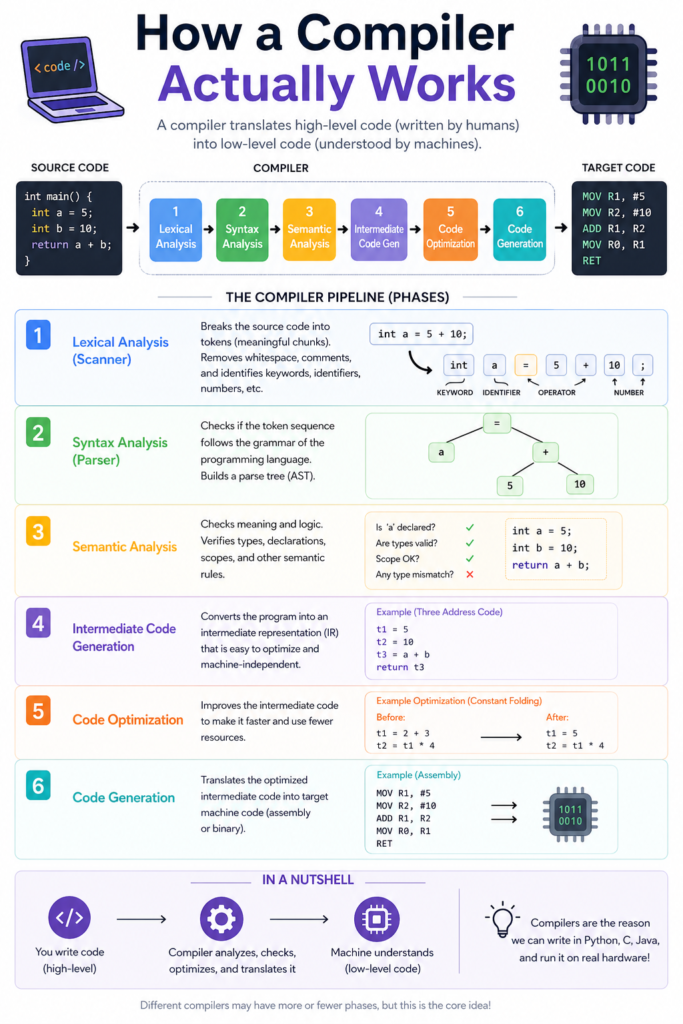
Tokens → Abstract Syntax Tree (AST) following grammar rules.
text
        return_stmt
        /          \
      PLUS         binary_op? no, just a+b
     /    \
  ID(a)   ID(b)
Better visualized as:
text
          function_definition
         /        |         \
     type: int   name: add   body (block)
                               |
                           return_stmt
                               |
                             binary_op: +
                             /        \
                        expr: a      expr: b
AST ignores punctuation like commas and semicolons — just structure.
Phase 3: Semantic Analysis
Checks meaning (type checking, scope, etc.).
Example:int a = "hello"; ← Type error, caught here.
Also builds a symbol table:
| Name | Type | Scope |
|---|---|---|
| add | int→int→int | global |
| a | int | param |
| b | int | param |
Phase 4: Intermediate Representation (IR) Generation
AST → lower-level, machine-independent IR (e.g., three-address code).
text
t1 = a + b
return t1
Or in LLVM IR style:
text
%result = add i32 %a, %b
ret i32 %result
IR is easier to optimize than raw AST.
Phase 5: Optimization
Optimize IR without knowing the target CPU.
Example improvements:
- Constant folding:
x = 3 + 5→x = 8 - Dead code elimination: remove
if (false) { ... } - Inline small functions: replace
add(a,b)witha+b
Phase 6: Code Generation
IR → assembly / machine code for a specific CPU (x86, ARM, etc.).
add(a, b) on x86-64 might become:
asm
lea eax, [rdi + rsi]   ; rdi = a, rsi = b, eax = result
ret
Then assembler + linker produce executable binary.
3. Visual Pipeline Summary (Text Diagram)
text
Source File
     │
     ▼
┌─────────────┐
│ Lexer       │ ──► token stream
└─────────────┘
     │
     ▼
┌─────────────┐
│ Parser      │ ──► AST
└─────────────┘
     │
     ▼
┌─────────────┐
│ Semantic    │ ──► annotated AST + symbol table
│ Analyzer    │
└─────────────┘
     │
     ▼
┌─────────────┐
│ IR Gen      │ ──► IR (three-address code)
└─────────────┘
     │
     ▼
┌─────────────┐
│ Optimizer   │ ──► optimized IR
└─────────────┘
     │
     ▼
┌─────────────┐
│ Code Gen    │ ──► assembly / machine code
└─────────────┘
     │
     ▼
Executable
4. Real Compiler Examples
| Compiler | Language | Phases combined |
|---|---|---|
| GCC | C/C++ | 6+ passes, many optimizations |
| Clang/LLVM | C/C++/Rust | clean separation: frontend (Clang) → IR → backend (LLVM) |
| javac | Java | source → bytecode (JVM IR) |
5. Key Takeaway
A compiler is not magic — it’s a deterministic pipeline:
- Lexer breaks text into tokens.
- Parser builds a tree (AST).
- Semantic validates types and scopes.
- IR flattens to lower-level ops.
- Optimizer improves IR.
- Code generator emits machine code.