

The Core Trio: Processes, Threads, Mutexes
text
┌─────────────────────────────────────────────────────────┐
│                    YOUR PROGRAM                          │
│                                                          │
│  ┌─────────────┐     spawns     ┌─────────────┐        │
│  │   PROCESS   │ ─────────────► │   THREADS   │        │
│  │  (heavy)    │                 │  (light)    │        │
│  └─────────────┘                 └──────┬──────┘        │
│                                          │               │
│                                    needs sync           │
│                                          │               │
│                                   ┌──────▼──────┐        │
│                                   │   MUTEX    │        │
│                                   │  (lock)    │        │
│                                   └─────────────┘        │
└─────────────────────────────────────────────────────────┘
1. Process: The “Running Program”
Mental model: A house.
- Has its own address space (rooms)
- Doesn’t share memory with other houses
- Expensive to build (fork) or move (context switch)
- Dies = house demolished
When you use it (daily):
- Running
node server.js→ one process pg_ctl start→ PostgreSQL process- Every terminal tab = separate shell process
Key commands you’ll actually type:
bash
ps aux              # list all processes
kill -9 1234       # force kill process 1234
top                # see CPU/memory per process
What you need to know (not trivia):
- Processes isolate failures — one crash doesn’t kill others
- Inter-process communication (IPC) is slow (pipes, sockets, files)
- Chrome uses one process per tab for this reason
2. Thread: The “Unit of Execution”
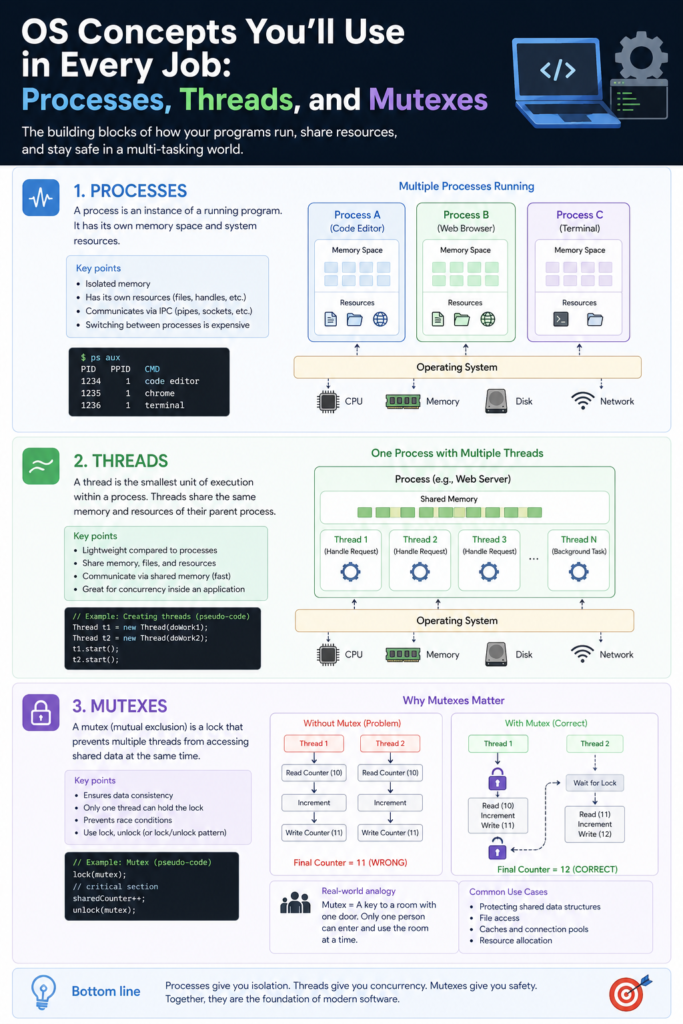
Mental model: Workers inside one house.
- Same house (memory), different workers
- Cheap to create and switch
- Can step on each other’s toes (shared data)
When you use it (daily — probably without realizing):
Web server handling requests:
python
# Flask/FastAPI (each request gets a thread)
@app.get("/user")
def get_user():      # runs in SOME thread
    return {"id": 1} # which thread? doesn't matter
Background task in GUI:
javascript
// Browser main thread (UI) vs Web Worker
setTimeout(() => {
  // This runs in main thread unless you use Worker
  alert("still responsive");
}, 1000);
Parallel processing:
python
from threading import Thread

def download(url):
    print(f"downloading {url}")

# 4 threads downloading simultaneously
threads = [Thread(target=download, args=(url,)) for url in urls]
for t in threads: t.start()
The real catch: Threads share memory → race conditions.
3. Mutex (Mutual Exclusion Lock)
Mental model: Bathroom key.
- Only one thread holds the key at a time
- Others wait outside
- Forgetting to return the key = deadlock
Problem it solves:
python
# BAD: Two threads incrementing balance
balance = 100

def add_money():
    global balance
    temp = balance    # Thread A reads 100
    temp = temp + 10  # Thread B also reads 100 (before A writes)
    balance = temp    # Both write 110, lost 10!
Solution with mutex:
python
from threading import Lock

balance = 100
lock = Lock()

def add_money():
    global balance
    lock.acquire()        # Get the key
    temp = balance
    temp = temp + 10
    balance = temp
    lock.release()        # Return the key
Real-world mutex you’ve seen:
- Database row lock:
SELECT ... FOR UPDATE - Git lock file:
.git/index.lock - File lock:
flockin shell scripts
The Three Rules You’ll Live By
Rule 1: Keep shared state minimal
python
# BAD: Shared counter
counter = 0
def worker():
    global counter
    counter += 1  # needs mutex EVERYWHERE

# GOOD: Local to thread
def worker():
    local_counter = 0  # no lock needed
Rule 2: Always acquire locks in the same order
python
# DEADLOCK waiting:
Thread A: lock(a) → lock(b)
Thread B: lock(b) → lock(a)  # B waits for A, A waits for B 💀

# FIX: Same order everywhere
Thread A: lock(a) → lock(b)
Thread B: lock(a) → lock(b)  # works
Rule 3: Use higher-level abstractions when possible
Instead of raw mutexes:
python
# Use queues
from queue import Queue
q = Queue()
q.put(data)      # thread-safe internally
data = q.get()

# Use atomic operations
counter = AtomicInteger(0)  # Java/C++
counter.increment()         # no explicit lock

# Use database transactions
BEGIN;
UPDATE accounts SET balance = balance - 100 WHERE id = 1;
UPDATE accounts SET balance = balance + 100 WHERE id = 2;
COMMIT;  # DB handles locking
Real Job Scenarios
Scenario 1: Backend API rate limiter
python
# Need to track requests per user across threads
requests_per_user = {}  # shared dict
mutex = Lock()

def rate_limit(user_id):
    with mutex:
        count = requests_per_user.get(user_id, 0)
        if count > 100:
            return False
        requests_per_user[user_id] = count + 1
    return True
Scenario 2: Loading cache in background
python
cache = {}
cache_lock = Lock()

def get_data(key):
    # Fast path: no lock for reading
    if key in cache:
        return cache[key]

    # Slow path: lock only for update
    with cache_lock:
        if key not in cache:  # double-check
            cache[key] = fetch_from_db(key)
    return cache[key]
Scenario 3: Logging from multiple threads
python
# Without mutex: lines get scrambled
# "2024-01-01 ER2024-01-01 INFO ROR"

log_lock = Lock()
def log(message):
    with log_lock:
        print(f"{datetime.now()} {message}")
        f.write(...)  # file write also needs lock
Visual Cheatsheet
text
┌────────────────────────────────────────────────────────────┐
│                        PROCESS                              │
│  ┌────────────────────────────────────────────────────┐   │
│  │  MEMORY (heap, stack, code, static data)           │   │
│  │                                                      │   │
│  │  ┌────────┐  ┌────────┐  ┌────────┐              │   │
│  │  │THREAD 1│  │THREAD 2│  │THREAD 3│              │   │
│  │  │        │  │        │  │        │              │   │
│  │  │ stack  │  │ stack  │  │ stack  │              │   │
│  │  │ regs   │  │ regs   │  │ regs   │              │   │
│  │  └───┬────┘  └───┬────┘  └───┬────┘              │   │
│  │      │           │           │                    │   │
│  │      └───────────┼───────────┘                    │   │
│  │                  │                                 │   │
│  │           ┌──────▼──────┐                         │   │
│  │           │   MUTEX     │ ← only one thread       │   │
│  │           │  (lock)     │   inside at once        │   │
│  │           └──────┬──────┘                         │   │
│  │                  │                                 │   │
│  │           ┌──────▼──────┐                         │   │
│  │           │ SHARED DATA │                         │   │
│  │           │ { balance,  │                         │   │
│  │           │   cache,    │                         │   │
│  │           │   users }   │                         │   │
│  │           └─────────────┘                         │   │
│  └────────────────────────────────────────────────────┘   │
└────────────────────────────────────────────────────────────┘
What You Actually Need to Remember
| Concept | Daily use | Don’t overthink |
|---|---|---|
| Process | Running services, ps, kill | Memory isolation, slow to create |
| Thread | Web servers, background tasks | Shared memory, race conditions |
| Mutex | Any shared counter/cache | Lock order, deadlocks |
The 80/20 rule:
- 80% of bugs come from shared state without mutexes
- 20% come from deadlocks (wrong lock order)
Your debugging toolkit:
bash
# See threads inside a process
ps -T -p <PID>
top -H -p <PID>

# Python: find deadlock
import faulthandler; faulthandler.enable()
# Kill -3 <PID> prints all threads and locks

# Common Java deadlock detection
jstack <PID>
Final Takeaway
You don’t need to implement schedulers or memory managers. You just need to remember:
- Processes = separate houses (expensive, isolated)
- Threads = workers in same house (cheap, shared)
- Mutex = bathroom key (only one at a time)