

In today’s digital age, when we think of supercomputers, Nvidia is a name that comes to mind. But recently, Nvidia has made a move in the field of quantum computing that experts are calling a “game changer.” That move involves a new way of solving problems using the Ising model.
What is the Ising model?
The Ising model is a simple yet powerful model of physics. To understand it, imagine a lattice with a tiny magnet (spin) placed at each corner. These magnets can point either upward (+1) or downward (-1). Each magnet interacts with its neighbors. The objective of this model is to find a configuration in which the total energy of the system is the lowest.
This is not a physics toy. Many complex real-world problems, such as traffic routing, drug design, or financial portfolio optimization, can be written as Ising models.
What’s new with Nvidia?
Traditionally, the Ising model has been very difficult to solve, especially when the number of spins is large (100 or more). This is an “NP-hard” problem. But this is where Nvidia’s GPUs (graphics processing units) come into their own.
Nvidia has developed a new algorithm on its CUDA-enabled GPUs that solves the Ising model very quickly. They combine this with simulations of quantum annealing.
Simply put: Parallelism:
A GPU contains thousands of tiny cores. Millions of spins of the Ising model can be updated simultaneously. Simulated annealing: GPUs perform this process so fast that what once took weeks now happens in seconds or minutes.
How it connects to quantum computing
True quantum computers are still in their infancy. They make errors (are noisy) and are expensive. Nvidia’s approach is a classical-quantum hybrid model. They say: “Until real quantum computers arrive, harness the power of the Ising model on GPUs.”
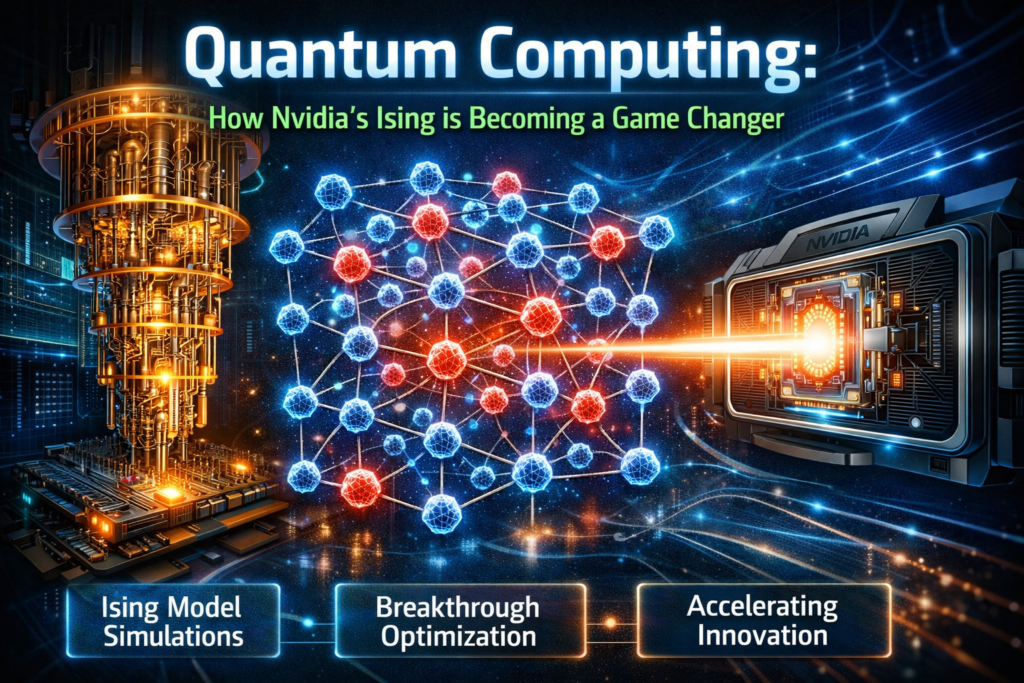
Nvidia’s innovation is the creation of the cuQuantum software development kit, which allows developers to simulate quantum circuits using GPUs. The Ising model is a key application of this.
Why a game changer?
Cost reduction: A typical company can buy an Nvidia GPU and solve its optimization problems, while a real quantum computer costs millions of rupees.
Accuracy: Simulations on GPUs are completely deterministic. It doesn’t make as many errors as today’s quantum hardware.
Scalability: Nvidia’s DGX Cloud and new Blackwell GPUs are so powerful that they can handle Ising models with millions of spins, which was previously impossible.
FAQs: Nvidia’s Ising Model Approach for Quantum Computing
A: Imagine a grid of tiny magnets where each magnet can point only up or down. The Ising model is a physics formula that calculates the total energy of this system. The goal is to find the arrangement of magnets that uses the least energy. This simple model can represent many real-world optimization problems, like traffic routing, drug discovery, or financial portfolio management.
A: Traditionally, solving large Ising models is extremely difficult (NP-hard) and slow. Nvidia uses its powerful GPUs (Graphics Processing Units) to run a technique called simulated annealing in parallel. Because GPUs have thousands of small cores, they can update millions of magnets (spins) simultaneously. This turns problems that used to take weeks into problems solved in minutes or seconds.
A: No, not directly. Instead, Nvidia is building tools to simulate quantum computing on classical GPUs. Their approach is called “classical-quantum hybrid.” They provide software like cuQuantum that allows developers to run quantum-like algorithms (such as Ising model solvers) on regular Nvidia GPUs. This works today, while real quantum hardware is still noisy and expensive.
A: Because it offers three major advantages:
Low Cost: Any company can buy a standard Nvidia GPU, whereas a real quantum computer costs millions of dollars.
High Accuracy: GPU simulations are error-free (deterministic), while current quantum computers make many errors due to “noise.”
Scalability: Nvidia’s new Blackwell GPUs and DGX Cloud can handle Ising models with millions of spins, which was previously impossible.
A: Researchers need to test and verify quantum algorithms before running them on expensive, error-prone quantum hardware. Nvidia’s GPUs allow them to simulate quantum circuits and Ising models at scale. This accelerates the development of future fault-tolerant quantum computers. In short, Nvidia provides the “digital twin” for quantum computing.